Six weeks after you hand the boat back, €640 can leave your card for a chip on the rudder blade. At that moment you argue with what you recorded on handover day. Nothing else.
No card, no signup · €19 only after the preview · survives brief signal drops at the marina
The base manager walks the boat with you, points out the sea cocks and the fire extinguisher, and mentions in passing that the next group is waiting. You pull out your phone: hull, deck, a scratch near the bow, a scuff on a fender. Thirty frames in ten minutes, a folder in your gallery, the date in the corner of the screen. The question feels closed.
A week later you return the boat. The manager walks around it, nods, wishes you a good flight. The deposit stays blocked — every operator works this way; the window is usually two to four weeks.
While you shoot on your phone, the manager fills in the operator's form: a checklist, condition marks, your signature at the bottom. The document goes into the company's system and lives there all season. When someone decides, six weeks later, where the chip on the rudder blade came from, that is the document they will open.
Your thirty frames stay in your gallery.
Three reasons. Each works on its own, and any one of them is enough.
The date and coordinates inside a file can be changed by a free app in ten seconds. The charter company's lawyer knows this. The chargeback team at your bank knows it too.
Thirty files in a gallery remain thirty files in a gallery: no document number, no address where an outside person could check they are genuine.
You say you shot them at handover. The operator says the chip appeared later. A third party has nothing to stand on, and it sides with the signed form.
Between those two points there is nothing left to fix. On the day the charge email arrives, the boat has been sailing with other crews for weeks, and the chip in question can no longer be examined. You remember you took photos, open the gallery and find thirty files that convince no one of anything.
The window where the situation is still manageable lasts forty-five minutes and closes the moment you cast off.
The only moment the record can still be created.
The manager nods. The deposit stays blocked.
An email that reads “damage to rudder blade”.
After this date Visa and Mastercard no longer accept the dispute.
A bank, an insurer and a small-claims court all run the same procedure: they check whether the file can be proven unchanged since the moment it was created. The honesty of the parties is not weighed in that procedure. The check needs three things.
The moment a frame leaves your phone, the server computes its hash — a string that changes if a single pixel is edited. a3f9…c21b
The UTC stamp is assigned on our side at upload. It cannot be changed from a phone and cannot be backdated.
Every report has a Document ID and a public address, verify.handoverboat.com/YOUR-ID. The base manager, the bank or a judge opens it without a password and checks the hashes.
Hull, deck, cockpit, sails, anchor, engine, bilge, galley, heads, safety gear, tender, documents. Every zone has an illustration, a one-line instruction and an example of the right shot. Plus 11 optional zones if you want a denser record. No yachting vocabulary required.
The hash and the server timestamp are assigned the moment a frame is sent. Damage gets a tag — scratch, dent, chip, wear — and one sentence. Progress saves after every zone and survives brief signal drops at the marina.
Document ID, public verify link, email delivery. The return inspection at the end of the week is part of the same €19: the same zones, before-and-after in one document.
HandoverBoat runs in the browser from a link — nothing to install, the inspection starts right at the gangway. If you prefer an app, the same inspection is in the App Store and on Google Play.
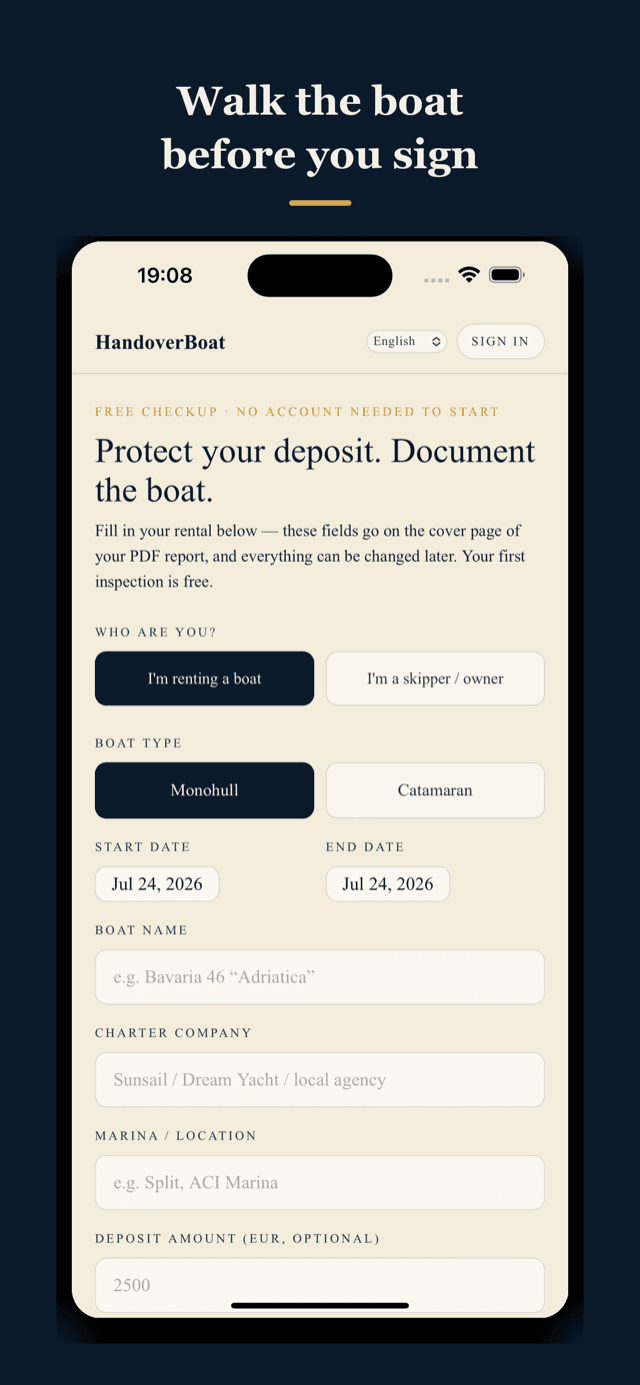
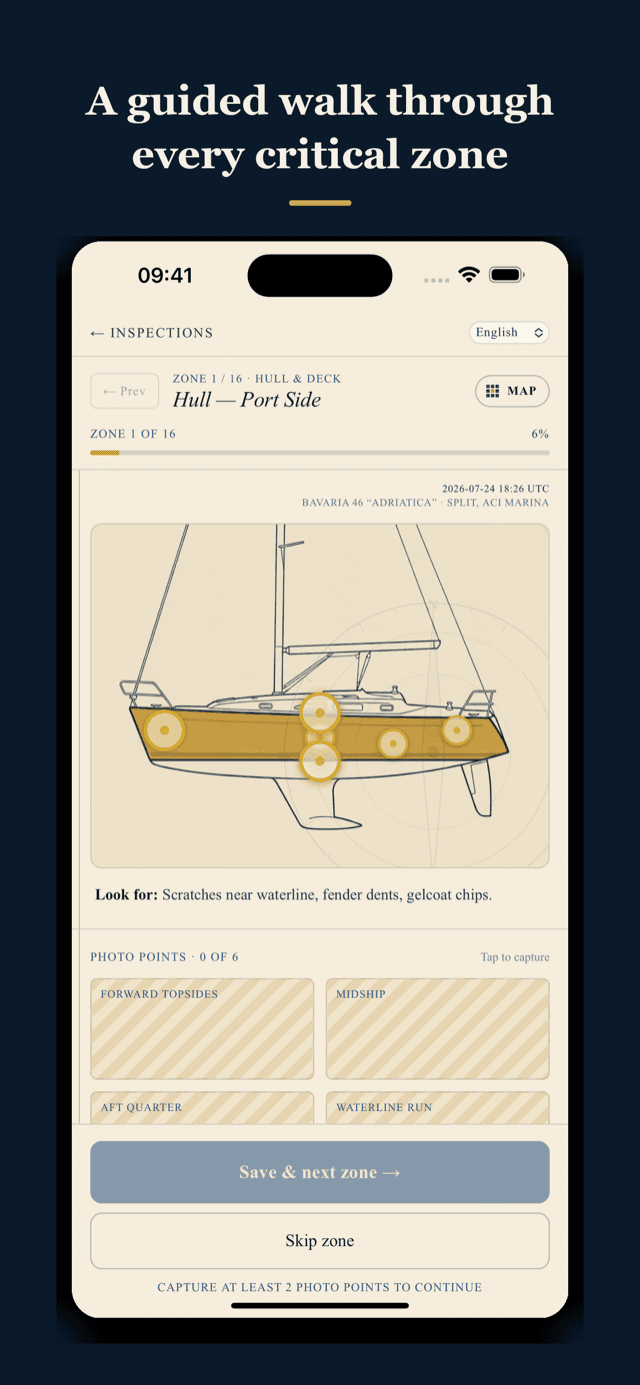
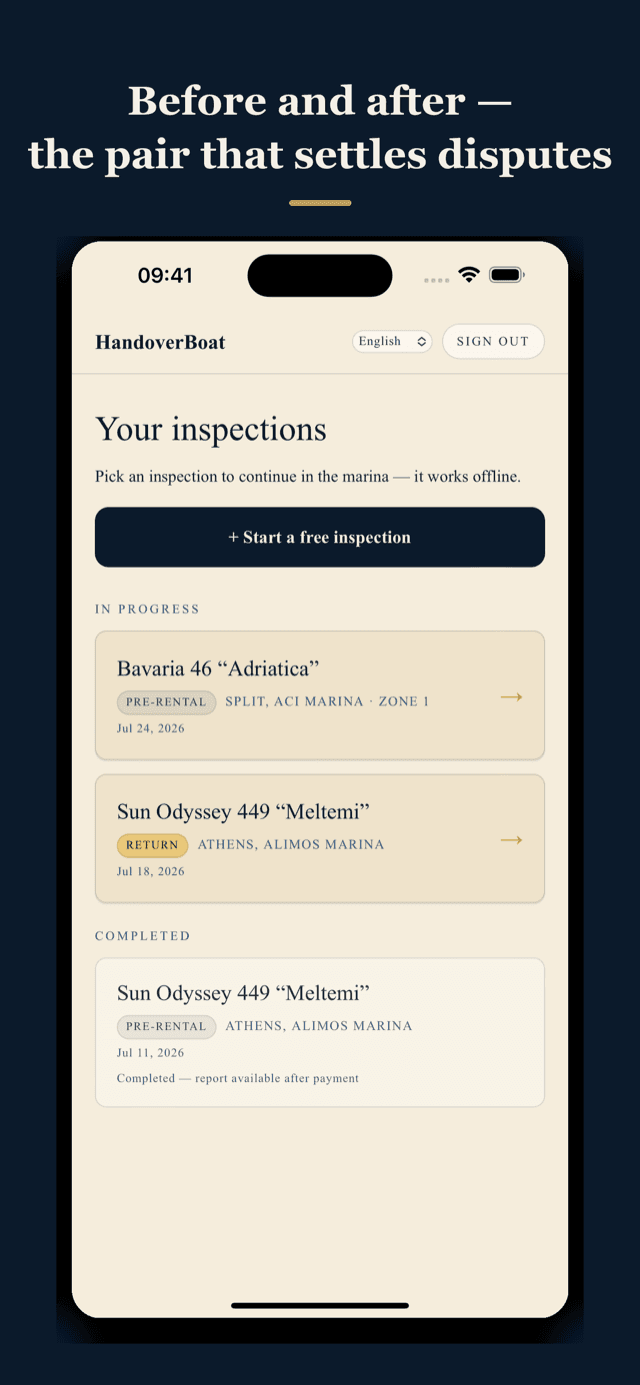


The same week in Split, lived twice. The difference between frame three and frame six costs €640.
Marina, a marketer from Warsaw. First bareboat, a Bavaria 38, a crew of six. €2,500 is blocked on her card.
The handover runs at the manager's pace. Thirty frames in ten minutes, a signature on the base's form, lines cast off.
The email says: a chip on the rudder blade. Marina opens her gallery and realizes she has no way to prove when the photos were taken.
Anton opens the link right at the gangway. No install, no signup, the first two zones free.
By zone six the screen shows a finished page with a timestamp and a verify link. The document reaches the base before departure.
At return — the same zones and before-and-after in one PDF. The dispute never starts: the base holds exactly the same record as the crew.
A real handover of a 38-foot yacht in Split: all 16 critical zones, 11 optional ones and three documented damages. See what a zone page looks like, where the Document ID sits, and what a person opening the verify link sees.
It is more honest to say this before you pay.
What we have learned about charter deposits — the data, the checklists, and what actually holds up in a dispute. (in English)
What to do, in what order, with what deadlines: written demand first, then escalation, then the card. Includes the fee most people trigger by going to the bank too early.
ResearchNobody in the yacht charter industry publishes deposit withholding rates. We triangulated four independent signals. Estimate: 15–25%, typically €200–800.
GuideEvery charter checklist says what to look at. This one says what each photo proves if the operator charges you six weeks later. 27 zones, 30–45 minutes.
The first two zones are free — no card and no signup. You will see the report cover, your frames, the timestamps, the Document ID and the verify link. Only the download button stays locked.
45 minutes at the dock · €19 after the preview · refund within 14 days for a technical fault
HandoverBoat helps you create a timestamped photo record of a boat handover. Deposit return is not guaranteed, the rental agreement is not replaced, and the report is not legal advice.